
Crocs: the EU General Court confirms the lack of individual character of the famous sandals
With the judgment of 22 April 2026 (case T-228/25), the General Court of the European Union confirmed the decision of the Third Board of Appeal of EUIPO of 5 February 2025, and, therefore, the invalidity of design no. 000257001-0001 registered by Crocs, represented below:
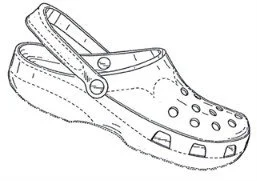
The design concerned the well-known model of sandals, characterized by:
perforated upper with circular holes;
rounded toe;
thick sole;
back strap.
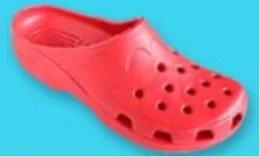
The case originated in 2022, when the Spanish company Gor Factory SA filed an application for a declaration of invalidity against the design registered by Crocs in 2004. According to the Spanish company, the design lacked individual character compared to an earlier design (“Holey Soles”), which had already been disclosed in 2003:
Both the Cancellation Division and the Board of Appeal of EUIPO upheld this argument, finding that the Crocs design did not comply with Art. 6 of Regulation (EC) No 6/2002 on Community designs (recently repealed by Regulation (EU) 2026/715 on European Union designs).
Crocs then appealed the Board's decision before the EU General Court, primarily contesting:
the assessment of the degree of freedom of the designer;
the comparison of the overall impressions between the designs;
the weight attributed to the back strap as a distinctive element of its registered design.
Crocs argued that the designer's freedom was limited by the functional requirements of the footwear, considering the shape, sole, and structure typical of sandals. The General Court, however, found that the creative margin was wide: the designer could therefore have differentiated the product under several aspects, such as materials, colors, decorations, and the arrangement of the holes. Precisely because the creative freedom was wide, more marked differences would have been necessary to stand out from the earlier design. In the comparison between the two designs, on the other hand, the General Court found significant similarities, in particular:
general shape and thickness of the sole;
very similar arrangement of the holes on the top and side parts.
Crocs further argued that the back strap represented a distinctive element, the result of specific design choices and globally recognizable. The General Court, however, considered it an accessory element, not essential to the structure and overall impression of the footwear and not sufficient to counterbalance the overall similarities between the models.
As further defenses, Crocs invoked the commercial success and the reputation of the product. On this point, however, the General Court reiterated that “in accordance with Article 6 of Regulation No 6/2002, the individual character of a design is assessed by comparing the overall impressions produced by the designs at issue on an informed user and by taking account of the designer’s freedom, the criteria relating to the design process of the contested design, the commercial success of the products depicted by that design, the renown those products have acquired among amateurs in the sector concerned and the contribution of the contested design to the sector concerned are not among those taken into account for the purpose of assessing the individual character of a design”.
Finally, Crocs referred to some favourable US decisions, but, on this point as well, the General Court recalled that the European system is necessarily autonomous and the decisions of foreign authorities therefore have no binding value.
The judgment therefore confirms that, in order to obtain protection, a design must distinguish itself clearly from what already exists when the designer has wide creative freedom, and that secondary elements or the commercial success of the product cannot offset a substantial similarity with earlier designs.