
By an order published on 6 October 2026, the Court of Venice granted copyright protection to Kartell’s famous “Componibili” modular storage units, designed by Anna Castelli Ferrieri in 1967, and enjoined the marketing of three competing products named “Oasi”, “Mirage” and “Eden”.
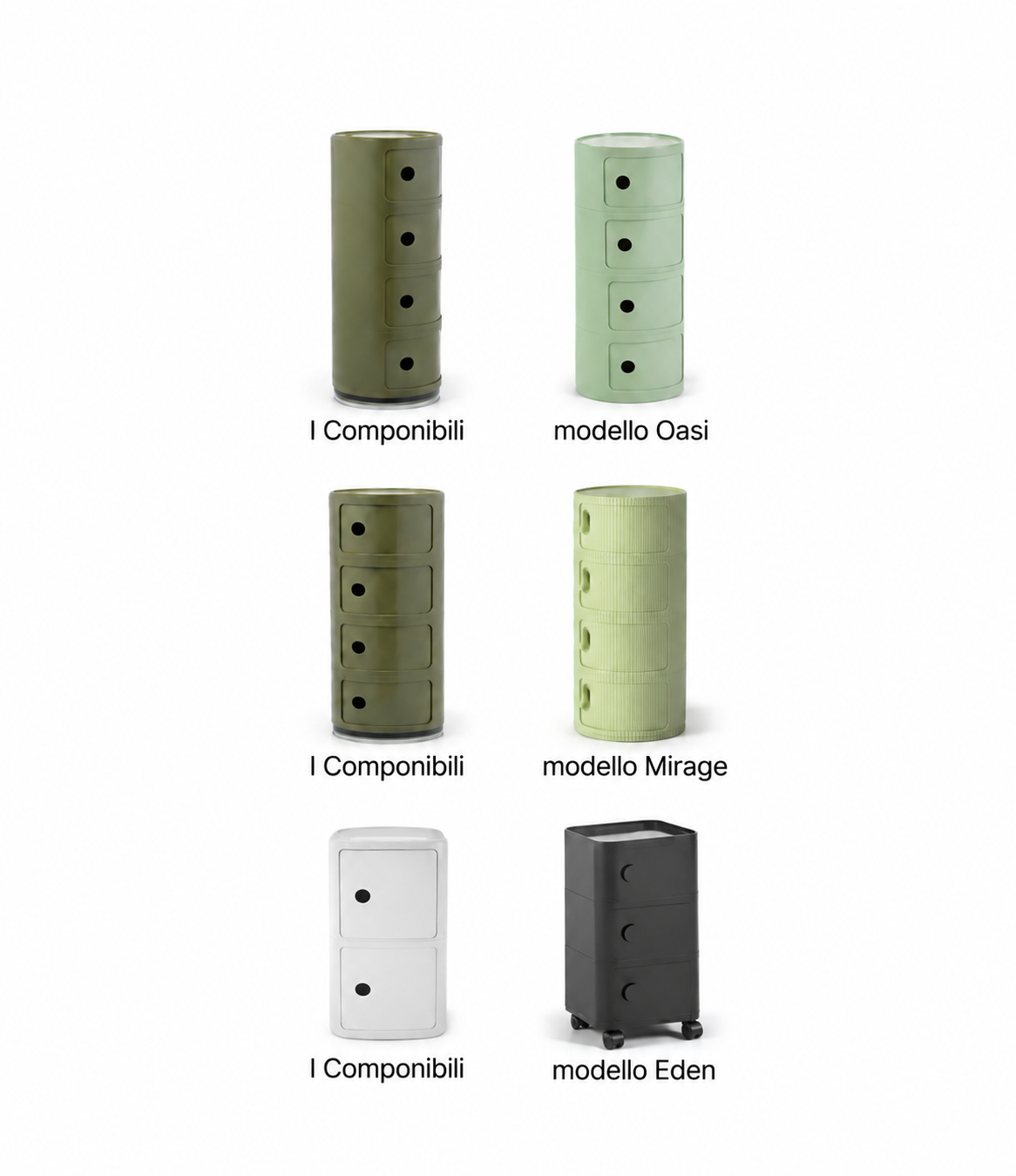
Photographic comparisons taken from the order of the Court of Venice
The Court first recalled, in line with EU legislation and case law, that copyright protection requires an original work that can be identified objectively and that reflects the author’s free and creative choices. Features dictated by technical or functional constraints that leave no room for creativity are excluded from protection.
The Court therefore identified the originality of the Componibili in the combination of geometric shapes, smooth surfaces, circular openings, side-opening compartments and modular construction, all resulting from design choices that were not dictated by technical or functional constraints. It also clarified that the possibility of varying their height by stacking different numbers of modules does not preclude protection: modularity is one of the work’s distinctive features and, in any event, the number of modules does not affect the harmony of its lines or the overall appearance of the products, nor does it prevent the work from being identified with sufficient precision and objectivity.
However, contrary to EU legislation and case law, the Court — as in several previous decisions by the same and other Italian courts — also considered it necessary to establish the existence of the “artistic value” required by Article 2(10) of the Italian Copyright Act, relying on traditional indicators developed in Italian case law, such as museum exhibitions, awards and specialist publications. Once again, the Court justified this additional requirement by the need to avoid excessively broad copyright protection in view of its long duration, and based its legitimacy on Article 17 of Directive 98/71/EC, under which “Each Member State shall determine the extent to which, and the conditions under which, such a [copyright] protection is conferred, including the level of originality required”.
As we have already noted in previous posts, this position is difficult to reconcile with the CJEU judgments in Cofemel and Mio/USM Haller, which we discussed, among other places, here and here on this blog. The CJEU has made it clear that works of industrial design cannot be subject to stricter requirements for copyright protection than other intellectual creations, nor can copyright protection depend on any particular aesthetic or artistic merit. Awards, exhibitions and professional recognition may, at most, contribute to the assessment of originality, but cannot be necessary conditions for protection. Nor does the desire to limit the duration and scope of exclusive rights appear capable of justifying this further requirement. Indeed, the risk is that protection will only be confined to iconic, long-established products, and not to more recent designs.
In the case at hand, the Court nevertheless found that artistic value had also been established, so this additional requirement did not ultimately prevent the Componibili from receiving copyright protection.
Turning to infringement, the Court found that “Oasi” was a substantially identical reproduction of the corresponding Componibili model. As regards “Mirage” and “Eden”, which featured certain variations, the Court recalled the distinction between creative elaboration and infringement, as well as the case law on so-called “evolutionary plagiarism”: an elaboration may be unlawful even if it does not reproduce the original slavishly, where the differences are merely formal or matters of detail and do not reflect an independent creative contribution. What matters, therefore, is the reproduction of the work’s creative elements, even where consumers would not confuse the two products. On that basis, the ribbed surface and linear handles of “Mirage”, as well as the variations in the compartments and handles of “Eden”, were regarded as minor modifications insufficient to rule out infringement.
The Court also found that all three contested products amounted to unfair competition through confusing slavish imitation under Article 2598(1) of the Italian Civil Code. It recalled that this form of unfair competition requires the reproduction of external features of a competitor’s product that are not dictated by technical or functional requirements and have distinctive character, meaning that they are capable of identifying the product as originating from a particular business. The likelihood of confusion must then be assessed from the perspective of the average consumer of the relevant products, through an overall appraisal of their appearance rather than an analytical examination of individual similarities and differences.
The Court rejected the other forms of unfair competition alleged by the applicant: misappropriation of a competitor’s merits under Article 2598(2) of the Italian Civil Code, since there was no indication that the defendant had attributed Kartell’s qualities or accolades to its own products; and parasitic competition under Article 2598(3), in the absence of evidence of systematic and continuous imitation.
In conclusion, the Court issued an injunction, ordered the products to be withdrawn from the market and removed from online sales platforms, and imposed penalties of €300 for each unit marketed in breach of the order and €200 for each day on which advertising for the prohibited products remained available. It also ordered the publication of an extract from the decision in two monthly magazines designated by the applicant, at the defendant’s expense, either by the defendant itself or, in the event of non-compliance, by the applicant.